Custom Clothing Manufacturer for UK Brands: Wings2Fashion's Sourcing Guide
Custom Clothing Manufacturer for UK Brands: Why Sourcing from India Just Changed
A UK founder researching a custom clothing manufacturer for UK brands right now is looking at a different cost picture than they would have a year ago. From 15 July 2026, the UK-India free trade agreement removes the existing import duty on Indian textiles and clothing entirely, a shift that changes the underlying economics of UK apparel sourcing from India more than any single factory negotiation could.
According to the House of Commons Library's official briefing on the agreement, the UK will eliminate tariffs on 99 percent of Indian tariff lines once the deal enters into force, and UK imports from India already stood at £28 billion in the year to September 2025. India's own government confirms the scope directly: a press release from India's Press Information Bureau states that textiles enter the list of sectors reaching zero duty under the agreement, alongside leather, marine products, and engineering goods.
This guide explains what a custom clothing manufacturer for UK brands sourcing from India now looks like, what import duty UK founders should expect after 15 July 2026, and how Brexit-era customs clearance still applies even as the tariff itself disappears.
Import Duty UK: What Changes From July 2026
Before the agreement, textiles and clothing imported from India into the UK carried a duty of around 12 percent under the UK Global Tariff, the schedule the UK put in place for countries without a preferential trade deal. From 15 July 2026, that 12 percent rate on textiles and clothing from India drops to zero, provided the shipment meets the agreement's rules of origin and carries a valid statement on origin.
This is a meaningful shift for UK apparel sourcing specifically, since clothing and footwear have historically sat among the higher-duty categories under the UK Global Tariff, commonly in the 10 to 12 percent range depending on the specific commodity code. A UK fashion label sourcing a bulk order of Indian-made garments at this rate saw a real cost, not a rounding error, and removing it changes the margin calculation on a first order meaningfully enough to affect pricing and reorder decisions.
The duty elimination is not automatic on every shipment. It depends on the exporter's documentation meeting the origin rules set out in the agreement, which is why working with a manufacturer that already understands the paperwork requirement matters as much as the tariff change itself.
Brexit Customs Clearance: What a UK Founder Still Needs to Handle
The end of the import duty does not remove the customs clearance process itself. Gov.uk's official guidance on importing goods into the UK confirms that every commercial shipment still needs a commodity code, an import declaration, and payment of any applicable VAT, regardless of whether customs duty itself is zero under a trade agreement. A UK founder or their customs agent still needs to classify the shipment correctly, since the commodity code determines whether an import licence is required in addition to determining the duty rate.
Brexit customs clearance for a UK fashion label typically involves an EORI number, a correctly classified commodity code from the relevant chapter of the UK's tariff schedule, and a customs declaration submitted through the UK's Customs Declaration Service, either directly or through a customs agent. Standard UK VAT, generally 20 percent, is charged on the value of the goods plus freight and insurance, separately from any customs duty, so a zero-duty shipment under the new agreement still carries a VAT bill a founder needs to budget for.
GBP Pricing: Budgeting a First Order in Pounds
A custom clothing manufacturer for UK brands typically quotes in US dollars, since that is the standard currency for export manufacturing invoices out of India, which means a UK founder is budgeting in GBP against a quote denominated in a currency that moves independently of the pound. This exchange rate exposure sits on top of, not instead of, the import duty and VAT calculation, and it is easy for a first-time founder to focus on the tariff change while underestimating how much a currency shift between quote and payment date can affect the final landed cost in pounds.
Locking in a GBP-equivalent budget early, and confirming whether a manufacturer quotes in a way that allows for currency fluctuation between deposit and balance payment, protects a UK apparel sourcing budget from a second cost variable arriving on top of the first.
Consider a UK startup importing a 500-unit order of hoodies quoted at 8 US dollars per unit, roughly 6.30 pounds at a typical exchange rate. Before 15 July 2026, a 12 percent import duty added close to 378 pounds to that order on top of freight and the standard 20 percent VAT charge. From 15 July 2026, the duty component disappears entirely for a shipment that meets the agreement's origin rules, leaving VAT and freight as the remaining landed costs. That 378 pounds is real margin a UK apparel sourcing budget can now redirect toward marketing, packaging, or a second colourway, rather than customs duty.
UK Fashion Label Sourcing: What UK Buyers Look For
UK retailers and marketplaces increasingly expect a UK fashion label to document its supply chain clearly, partly because UK consumers have shown sustained interest in where a garment is made and under what conditions. A custom clothing manufacturer for UK brands that can provide clear factory documentation, fabric sourcing detail, and consistent quality control between sample and bulk order removes one of the more common friction points UK founders encounter with a first overseas manufacturer.
UK apparel sourcing from India specifically benefits from India's largely domestic textile supply chain, since fabric sourced and processed within the same country the garment is cut and sewn in creates a shorter, more traceable supply chain than one spanning several countries for fibre, yarn, and finished textile.
Labelling and Compliance a UK Fashion Label Still Needs
Removing import duty does not remove the UK's product labelling requirements. Every textile product sold in the UK still needs to display its fibre content clearly, whether that is a single-fibre claim like "100% cotton" or a blended composition listing each fibre by weight. A custom clothing manufacturer for UK brands should confirm fibre content labelling as part of the tech pack and bulk order process, since a compliant garment that arrives with incorrect or missing labelling still creates a customs and retail compliance problem, even at zero duty.
Children's clothing and certain protective garments also carry additional UK safety and labelling requirements beyond standard fibre content rules, which a UK fashion label sourcing from a new manufacturer should confirm applies to their specific category before finalizing a bulk order.
Private Label UK Brand vs Custom Cut and Sew for UK Startups
A UK startup approaching a custom clothing manufacturer for UK brands generally chooses between two starting points. A private label UK brand builds on an existing base garment style with custom branding, labels, and packaging layered on top, which suits a founder testing a category or launching a first collection on a limited budget. A fully custom cut and sew programme builds an original pattern from scratch, which suits a founder whose competitive advantage lives in a specific silhouette or construction detail.
At Wings2Fashion, both paths are available at a UK-accessible MOQ of 50 pieces per style with mixed sizing, which keeps either route open to a UK startup without forcing a full-scale commitment before the brand has proven demand domestically. A clothing manufacturer for UK startups needs to support both models under one roof, since many founders start with private label and shift specific hero styles into custom cut and sew once those styles prove themselves with UK customers.
The choice also affects how quickly a UK startup can respond to early sales data. A private label UK brand can reorder an existing base garment style within weeks of confirming which colourway or size sold fastest, while a custom cut and sew reorder still benefits from the pattern already being developed, even though the initial development timeline was longer. A clothing manufacturer for UK startups that makes this tradeoff clear upfront helps a founder plan cash flow around the right model rather than discovering the difference mid-season.
Not sure which route fits your first UK collection? Contact Wings2Fashion with your product and budget, and the team will map a private label or cut and sew path suited to your launch timeline.
How Wings2Fashion Supports UK Apparel Sourcing
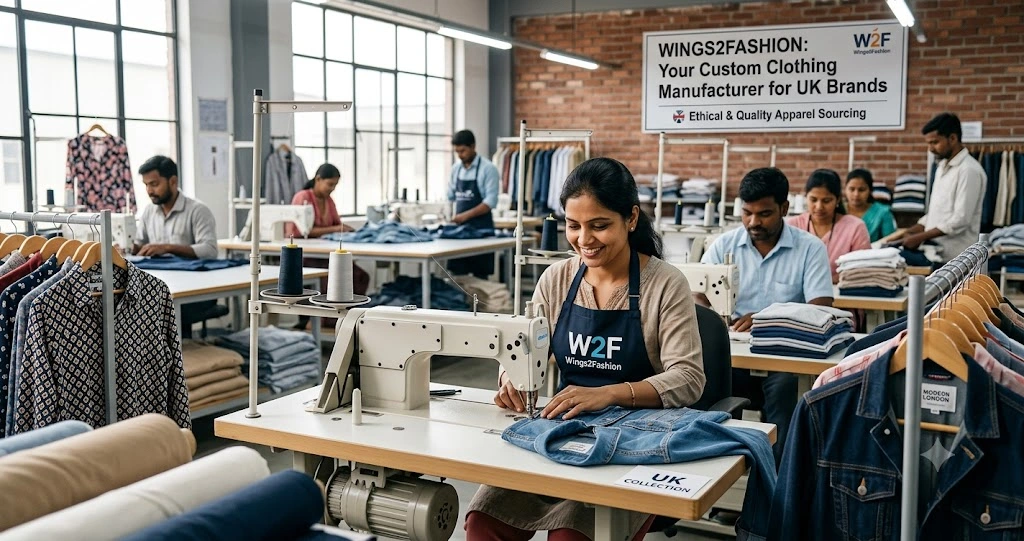
Wings2Fashion works as a custom clothing manufacturer for UK brands across women's wear, menswear, kidswear, and activewear, serving founders and boutique owners from London, Manchester, Birmingham, Leeds, Bristol, Glasgow, and Edinburgh. Every order runs through in-house production with multi-stage quality checks comparing bulk output against the approved sample, which addresses the most common complaint UK founders raise about a first overseas manufacturer: a sample that looked right followed by a bulk order that did not match it.
The Wings2Fashion UK programme covers fabric sourcing, private labelling, and full package production, with a dedicated contact managing each order from initial brief through shipment, which matters more once the tariff advantage narrows the price gap and quality consistency becomes the deciding factor between manufacturers.
FAQ's About Custom Clothing Manufacturer for UK Brands
Does the UK-India trade agreement remove all costs on clothing imports?
No. It removes the customs duty specifically, provided the shipment meets the agreement's rules of origin. UK VAT, generally 20 percent, still applies on top, along with freight, insurance, and any customs agent fees.
Do I still need an EORI number to import from India after the agreement takes effect?
Yes. An EORI number, a correctly classified commodity code, and a customs declaration are still required for every commercial shipment, regardless of the duty rate that applies.
Is a private label UK brand cheaper to launch than a custom cut and sew line?
Generally yes for a first order, since a private label UK brand builds on an existing base garment style rather than funding original pattern development, which lowers both cost and MOQ for a first collection.
How does GBP pricing work if my manufacturer quotes in US dollars?
Confirm the exchange rate assumption behind the quote and how currency movement between deposit and balance payment is handled, since a quote in US dollars still needs to be budgeted and reconciled against your UK apparel sourcing budget in pounds.
Do I still need to label fibre content correctly if the duty is zero?
Yes. UK labelling requirements for fibre content, and additional safety requirements for categories like children's clothing, apply regardless of the customs duty rate on the shipment.
Sourcing From India as a UK Fashion Brand After July 2026
The UK-India free trade agreement changes the cost side of the sourcing decision for a custom clothing manufacturer for UK brands, but it does not remove Brexit-era customs clearance, VAT, or currency exposure from the equation. A UK apparel sourcing budget built around the new zero-duty rate, correct customs documentation, and a realistic GBP conversion still needs a manufacturing partner who can execute consistently between sample and bulk order.Ready to plan your first order under the new duty structure? Get in touch with Wings2Fashion with your product category and target launch date, and the team will confirm cost, MOQ, and documentation for your UK collection.
Must Read:
 +919540322227
 info@wings2fashion.com



 Category



 Best Clothing Manufacturers for Startups USA
 Step-by-Step Garment Manufacturing Process
 Custom Streetwear Manufacturer for Global Brands
 How Much Does It Cost to Start a Clothing Brand?
 Best Garment Manufacturer Australian Brands
 Custom Clothing Production for European Fashion Brands
 Sustainable Hoodie Manufacturer for Startups
 Top 25 Women's Western Wear Trends
 How to Verify a Clothing Manufacturer Before You Pay a Deposit
 Free Tech Pack Template for Startups
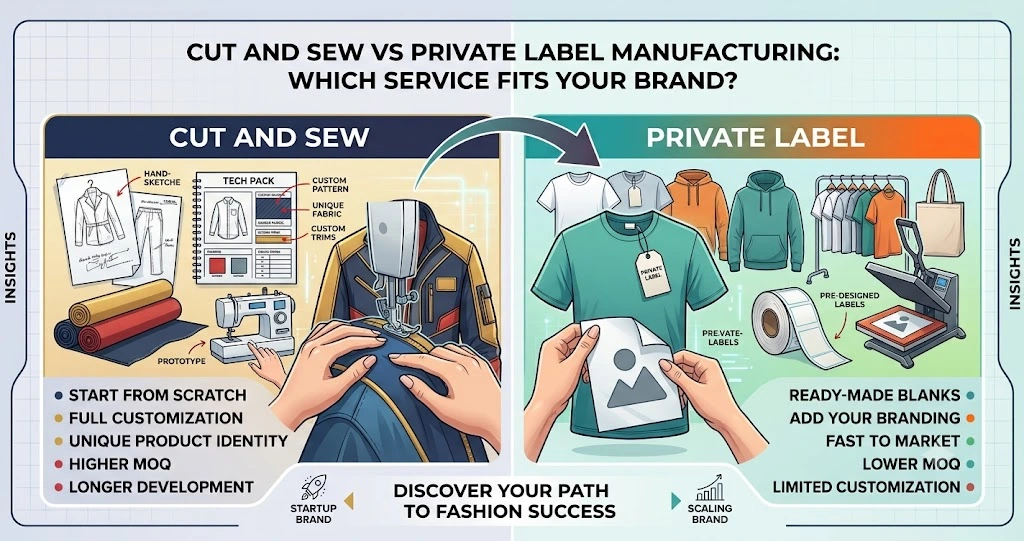 Cut and Sew vs Private Label Manufacturing
 MOQ in Clothing Manufacturing
 India vs China Clothing Manufacturing
 Plus Size Clothing Manufacturing
 Athleisure Manufacturing Trends
 Best Trending Styles Polo T-Shirts for Men
 Top 10 Custom Tracksuit Manufacturers With Low MOQ
 Black Essentials Hoodie Outfit Ideas for Every Season
 2026-09-12
 Suraj Vats





Leave A Comment