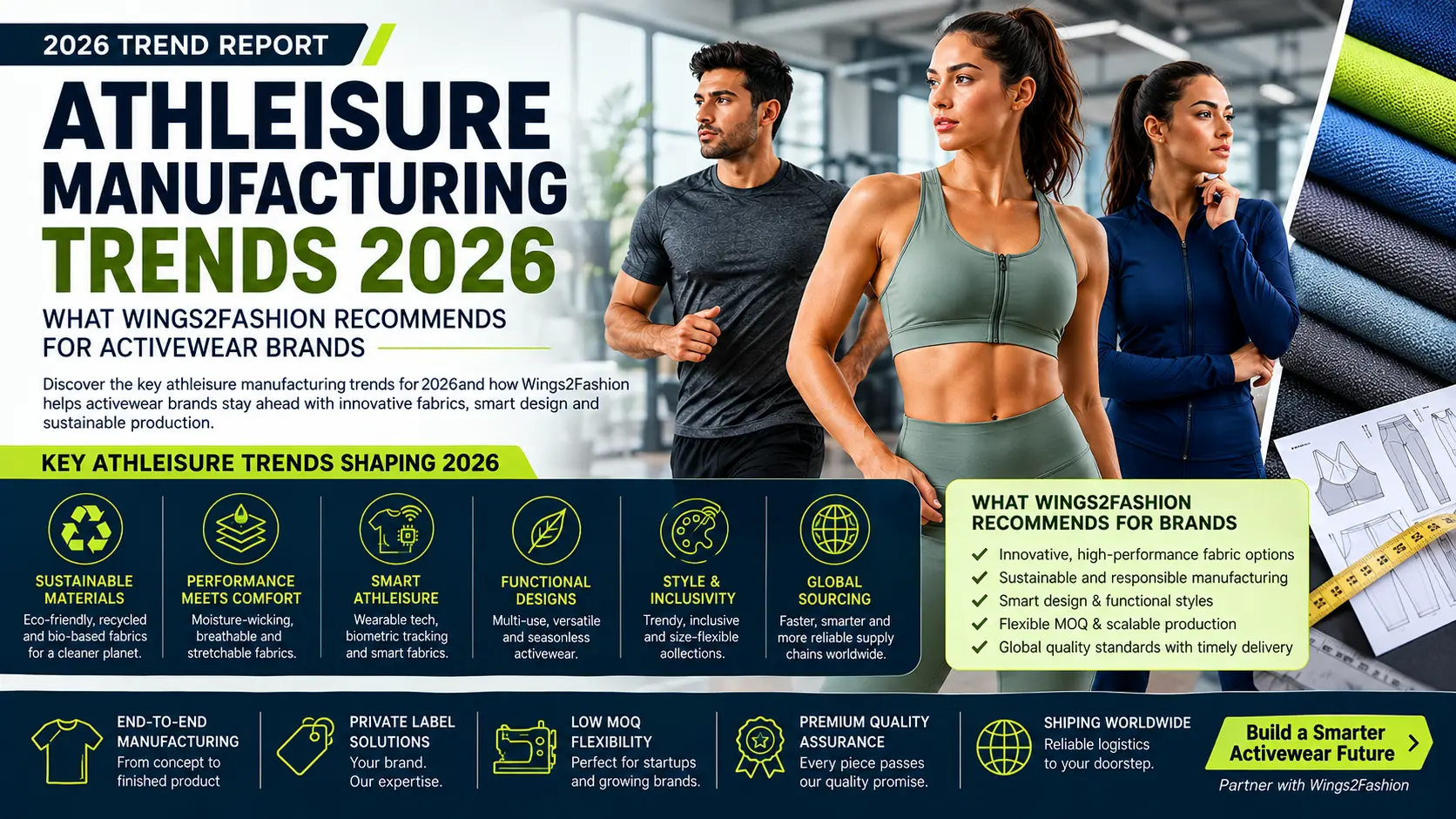
Athleisure Manufacturing Trends 2026: What Wings2Fashion Recommends for Activewear Brands
Athleisure Manufacturing Trends 2026: A Category Still Growing While Fashion Slows
Athleisure manufacturing trends 2026 are playing out against an unusual backdrop: a broader fashion industry growing slowly, and activewear growing considerably faster than almost everything around it. Grand View Research values the global athleisure market at 422.04 billion US dollars in 2025, projected to reach 892.48 billion dollars by 2033 at a compound annual growth rate of 9.9 percent. McKinsey's State of Fashion 2026 report frames this directly: while the broader fashion industry is projected to post low single-digit growth in 2026, sportswear remains one of the category's genuine bright spots, growing well ahead of the wider apparel market.
For a brand planning next season's range, this gap between category growth and general fashion growth means the manufacturing decisions behind athleisure carry more weight than they would in a flatter category. Fabric performance, construction method, and sustainability sourcing are no longer secondary considerations layered onto a design. They are becoming the actual competitive differentiators, particularly as more brands enter a growing category and compete on execution rather than simply on being present in the space.
This guide covers the athleisure manufacturing trends worth prioritizing for 2026, from performance fabric sourcing and moisture wicking fabric innovation to seamless activewear construction, compression wear, and recycled polyester activewear.
Performance Fabric Sourcing: Moisture-Wicking Fabric Innovation
Performance fabric sourcing has moved well past treating "moisture-wicking" as a single generic claim. Academic textile research on twisted profile filament and spun combination yarns found that different yarn structures perform very differently depending on how much liquid the fabric actually needs to move, meaning a fabric optimized for heavy, continuous sweat output does not necessarily perform the same way under lighter, intermittent moisture conditions. A performance fabric sourcing decision built only around a generic "moisture-wicking" spec, without matching the yarn structure to the actual use case, can under-deliver on exactly the performance claim a brand is making.
More recent fabric engineering pushes this further. Research on bioinspired nanoneedle composite fabrics reported a one-way liquid transport value of up to 330 percent and a water evaporation rate roughly 2 to 2.3 times higher than Coolmax, one of the established commercial benchmarks for moisture-wicking performance. For a brand entering the performance end of activewear, this signals that moisture wicking fabric technology is still advancing quickly, and a fabric spec locked in even two or three years ago may already be behind what performance fabric sourcing can now deliver.
Seamless Activewear: Why Construction Is Becoming a Bigger Differentiator Than Fabric
Seamless activewear construction eliminates the stitched seams that can cause chafing and pressure points during movement, knitting the garment to shape rather than cutting and sewing flat panels together. This matters increasingly for comfort-sensitive categories like leggings, sports bras, and base layers, where a seam in the wrong place is one of the more common reasons a customer returns an otherwise well-fitting garment.
Academic research on seamless knitted fabric structure demonstrates how fiber blend and knit structure together affect skin-contact performance beyond fit alone, extending to how the fabric manages moisture directly against skin over extended wear. Seamless activewear is not simply a fit upgrade over cut-and-sew construction. The knitting process itself changes how the fabric performs against skin, which is why seamless activewear commands a real, defensible price premium rather than functioning as a marketing distinction alone.
For a brand weighing whether seamless construction is worth the added development cost, the return-rate angle is often the more persuasive argument than the comfort claim alone. A legging or sports bra returned because of chafing or an uncomfortable seam placement is a lost sale plus a reverse logistics cost, and seamless activewear removes one of the more common physical causes of that return before it happens, rather than relying on sizing or styling adjustments to solve a construction problem.
Compression Wear: What Brands Should Know Before Specifying It
Compression wear applies graduated pressure through fabric tension and construction, most commonly in leggings, base layers, and recovery garments, and it depends on precise fit rather than fabric choice alone. A compression garment cut even slightly loose loses most of the functional benefit the category is built around, which makes grading accuracy more critical for compression wear than for looser athleisure silhouettes.
A brand specifying compression wear should confirm the fabric's stretch and recovery percentage alongside the grading rules used across the size range, since a compression effect calibrated correctly at one size can become too tight or too loose at another if the grading does not account for how compression fabric behaves differently from a standard four-way stretch knit used in relaxed athleisure pieces.
Consider a legging line graded using the same stretch percentage assumption at every size. A compression legging fitted correctly at a size Medium can end up over-compressing at a size Small, where the same fabric tension is applied across less body surface area, and under-compressing at a size Large, where the fabric has to stretch further to achieve the same graduated pressure. This is a different grading problem than a standard non-compression legging faces, and it is why compression wear needs its own fit testing across the size range rather than borrowing grading rules from a brand's existing relaxed-fit styles.
Recycled Polyester Activewear: Sustainability as a Sourcing Requirement, Not a Marketing Line
Recycled polyester activewear has moved from a niche sustainability claim to a mainstream material choice. Grand View Research reports that apparel accounts for the largest share of the recycled polyester market, at just over 51 percent of revenue, driven specifically by its moisture-wicking, quick-drying, and durability characteristics in activewear applications, not sustainability messaging alone.
This matters for a sourcing conversation in two ways. First, recycled polyester activewear now performs comparably to virgin polyester on the technical properties that actually matter in activewear, which removes the old tradeoff between sustainability and performance. Second, buyers and retailers increasingly expect a specific answer about recycled content percentage and sourcing, not a general sustainability statement, the same pattern already showing up in certification requirements across other apparel categories.
Activewear Manufacturer Trends by Category
Activewear manufacturer trends do not apply uniformly across every product type in a collection, and treating leggings, sports bras, and outerwear as if they need identical specifications is a common planning mistake.
- Leggings and base layers: benefit most from seamless activewear construction and precisely graded compression wear, since these categories sit closest to skin and are most sensitive to seam placement and fit accuracy.
- Sports bras: combine compression wear grading with moisture wicking fabric in the highest-contact zones, making both variables critical simultaneously rather than independently.
- Gym tops and training tees: prioritize moisture wicking fabric and breathability over seamless construction, since these looser-fit categories are less sensitive to seam placement.
- Outerwear and joggers: often blend recycled polyester activewear fabrics with more traditional cut-and-sew construction, since seamless knitting is less relevant to heavier, structured pieces.
Activewear manufacturer trends worth tracking into next season increasingly treat these as category-specific decisions rather than a single fabric and construction spec applied across an entire range.
Planning your next activewear collection and not sure which fabric or construction trend is worth the investment? Contact Wings2Fashion with your category and budget, and the team will confirm which performance fabric sourcing and construction options fit your range.
Activewear Manufacturer Trends: What to Prioritize for Next Season
Given where athleisure manufacturing trends 2026 are heading, a brand planning a range should prioritize:
- Matching moisture wicking fabric yarn structure to the actual use case, rather than treating "moisture-wicking" as a single generic spec
- Testing seamless activewear construction for comfort-sensitive categories like leggings and sports bras, where seam placement affects both fit and returns
- Confirming compression wear grading rules account for how compression fabric behaves differently across a size range compared with standard stretch knits
- Specifying recycled polyester activewear with a confirmed recycled content percentage, ready to state clearly to retailers and marketplaces
- Reviewing performance fabric sourcing specs against current fabric technology, since moisture-wicking and evaporation performance continues to improve year over year
How Wings2Fashion Supports Activewear and Athleisure Brands
Wings2Fashion runs activewear and gym wear manufacturing covering leggings, sports bras, gym tops, joggers, yoga wear, training shorts, compression wear, and full athleisure collections, built with performance fabrics, moisture-wicking technology, and stretchable materials suited to both fitness and everyday wear. Across sportswear manufacturing, fabric sourcing is matched to the specific category, whether that is a moisture wicking fabric optimized for high-output training or a seamless construction suited to a base layer or legging line, rather than a single fabric spec applied across the full range.
Frequently Asked Questions About Athleisure Manufacturing Trends 2026
Is seamless activewear worth the extra cost over cut-and-sew construction?
For comfort-sensitive categories like leggings, sports bras, and base layers, seamless construction reduces chafing and pressure points in ways that directly affect return rates, making it a defensible investment rather than a purely cosmetic upgrade.
Does recycled polyester activewear perform as well as virgin polyester?
Yes, on the technical properties that matter most in activewear. Recycled polyester now performs comparably on moisture-wicking, quick-drying, and durability, which is part of why it has become the leading material in the recycled apparel segment rather than a compromise choice.
How is compression wear different to grade across a size range?
Compression wear depends on precise fabric tension, so grading rules need to account for how the compression effect changes across sizes, rather than applying the same stretch percentage assumptions used for looser, non-compression athleisure pieces.
What is the biggest mistake brands make with performance fabric sourcing?
Treating moisture-wicking as one generic spec rather than matching the yarn structure and fabric technology to the actual use case, since fabrics optimized for different sweat volumes and activity types perform differently from one another.
Do all activewear categories need the same fabric and construction specification?
No. Leggings and base layers benefit most from seamless construction, sports bras need combined compression grading and high-contact moisture wicking, and looser categories like gym tops prioritize breathability over seam placement, so activewear manufacturer trends should be applied by category rather than uniformly.
Planning Your Next Athleisure Collection
Athleisure manufacturing trends 2026 point toward fabric and construction choices that were niche just a few years ago, moisture wicking fabric engineered for specific use cases, seamless activewear construction, precisely graded compression wear, and recycled polyester activewear with a confirmed content percentage, becoming standard expectations rather than premium add-ons. A brand that treats these as sourcing requirements rather than marketing language is better positioned as the category continues to outgrow the broader fashion market. The brands that struggle over the next few seasons will likely be the ones still specifying activewear the same way they did three or four years ago, while the fabric technology and construction options available have moved on considerably.
Ready to plan your next activewear or athleisure range? Get in touch with Wings2Fashion with your category and performance requirements, and the team will confirm fabric, construction, and timeline for your collection.
Must Read:
 +919540322227
 info@wings2fashion.com



 Category



 Best Clothing Manufacturers for Startups USA
 Step-by-Step Garment Manufacturing Process
 Custom Streetwear Manufacturer for Global Brands
 How Much Does It Cost to Start a Clothing Brand?
 Best Garment Manufacturer Australian Brands
 Custom Clothing Production for European Fashion Brands
 Sustainable Hoodie Manufacturer for Startups
 Top 25 Women's Western Wear Trends
 How to Verify a Clothing Manufacturer Before You Pay a Deposit
 Free Tech Pack Template for Startups
 Cut and Sew vs Private Label Manufacturing
 MOQ in Clothing Manufacturing
 India vs China Clothing Manufacturing
 Custom Clothing Manufacturer for UK Brands
 Plus Size Clothing Manufacturing
 Best Trending Styles Polo T-Shirts for Men
 Top 10 Custom Tracksuit Manufacturers With Low MOQ
 Black Essentials Hoodie Outfit Ideas for Every Season
 2026-08-18
 Suraj Vats





Leave A Comment