Cut and Sew vs Private Label Manufacturing: Which Wings2Fashion Service Fits Your Brand
Cut and Sew vs Private Label: The Decision That Shapes Your Margins and Your Brand
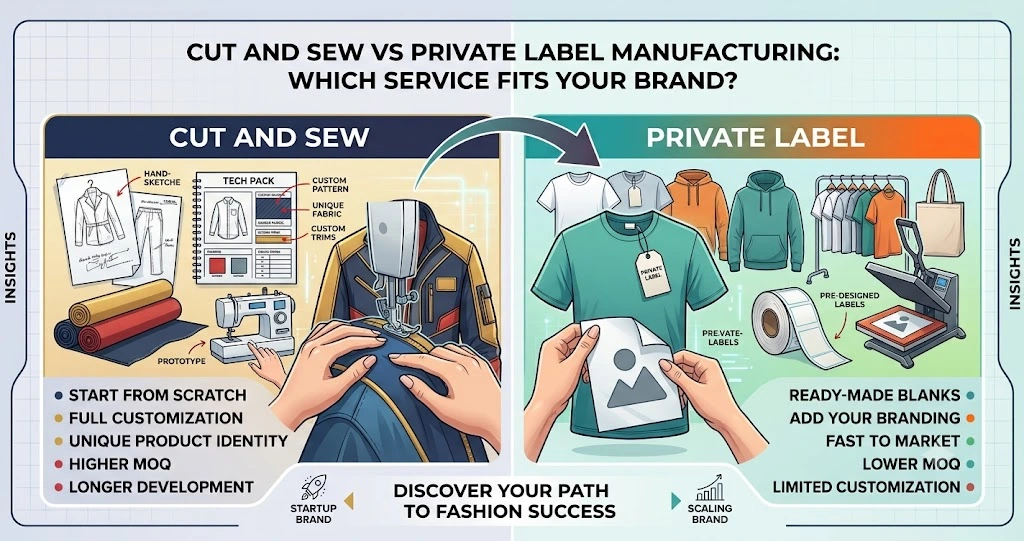
Every founder approaching a manufacturer eventually hits the same fork. Build a garment from scratch around an original pattern, or start from an existing base style and brand it as your own. Cut and sew manufacturing and private label manufacturing solve different problems, and picking the wrong one for your stage of business shows up later as either wasted development spend or a product that looks like everyone else's.
The decision matters more now than it did five years ago. Statista reports that private label's share of the US consumer goods market grew from 18 percent in 2019 to close to 21 percent by 2024, and McKinsey's research on private brands found that private-brand penetration in Europe reached 38 percent in 2023, against 19 percent in the United States, a gap that is closing as US retailers catch up. Private label is no longer a fallback option. It is a serious go-to-market model, and cut and sew is not automatically the safer choice just because it is the more custom one.
This guide explains what cut and sew manufacturing and private label manufacturing actually involve, where each one wins on cost and speed, and how Wings2Fashion supports both models depending on where your brand is right now.
What Cut and Sew Manufacturing Actually Means
Cut and sew manufacturing builds a garment from an original pattern developed specifically for your brand. Nothing is adapted from an existing block. Custom pattern making starts with your measurements, your silhouette, and your construction preferences, and the factory cuts fabric and builds the garment around that pattern from the first sample onward.
This is full package production in its most complete form: fabric sourcing, custom pattern making, sample development, grading, and bulk production, all built around a design that exists nowhere else. A brand doing cut and sew manufacturing owns its silhouette outright. No other label is selling the same cut from the same block.
The tradeoff is time and upfront cost. Custom pattern making takes longer than pulling a pattern off a shelf, and a first sample built from a new pattern usually needs more fit rounds than a sample built from a proven private label block.
What Private Label Manufacturing Actually Means
Private label manufacturing starts from a base garment style the manufacturer already produces and builds your brand on top of it. Blank apparel customization covers the branding layer, custom neck labels, hang tags, packaging, and in some cases fabric or colorway changes, applied to a silhouette that is already fit-tested and production-ready.
At Wings2Fashion, private label manufacturing covers custom labels, branded packaging, exclusive colorways, and silhouettes adapted from proven base garment styles, available across women's wear, men's wear, activewear, and kidswear. Because the base garment style is already fit-approved, private label manufacturing moves faster from brief to bulk order than a cut and sew program starting from a blank page.
The tradeoff runs the other way from cut and sew. Blank apparel customization is faster and cheaper to launch, but the base garment style is not exclusive to your brand unless you negotiate exclusivity, and differentiation depends entirely on branding, colorway, and fabric choices layered on top of a shared foundation.
Cut and Sew vs Private Label: Cost, MOQ, and Timeline Compared
The two models diverge on nearly every practical axis a founder budgets around.
- Pattern development. Cut and sew manufacturing requires custom pattern making from scratch. Private label manufacturing starts from an existing, pre-graded base garment style.
- Sample rounds. A cut and sew sample typically needs more fit rounds since the pattern is unproven. A private label sample usually needs fewer, since the block is already tested.
- MOQ. Private label manufacturing generally supports lower minimums per style, since the base garment style spreads risk across multiple brands using the same block. Cut and sew MOQs tend to run higher to justify the custom pattern development cost.
- Timeline. Private label manufacturing moves faster from brief to bulk order. Cut and sew manufacturing takes longer up front but produces a silhouette no other brand can offer.
- Differentiation. Cut and sew manufacturing gives full ownership of the silhouette. Private label manufacturing differentiates through branding, fabric, and colorway rather than pattern.
McKinsey's analysis of private-brand sourcing found that excellence in private-brand sourcing can reduce cost of goods sold by 10 to 15 percent compared with developing a product from scratch, which is consistent with why private label manufacturing remains the lower-cost entry point for a first collection.
Consider two founders launching the same season. The first chooses cut and sew manufacturing for a structured blazer with a proprietary shoulder construction. Custom pattern making, two to three fit rounds, and grading across the size range push the sample timeline to five or six weeks before bulk production even starts. The second chooses private label manufacturing for a core hoodie style, working from an existing base garment style with a custom label and colorway. The first sample is ready in two to three weeks, because the pattern is already proven and only the branding layer is new. Both founders reach bulk production eventually, but the private label manufacturing path gets there first, and the cut and sew manufacturing path arrives with a silhouette nobody else is selling.
When Cut and Sew Manufacturing Makes Sense
Cut and sew manufacturing earns its higher upfront cost when the silhouette itself is the brand's competitive advantage. A peer-reviewed study on apparel customization brand value found that consumers judge a customization-focused apparel brand on the combination of perceived product quality, brand image, and brand experience, not on price alone, which supports investing in custom pattern making when the brand's identity depends on a distinct fit or construction. A separate study on customized products, built around web toolkits for t-shirt customization, found that customer attitude toward a customized product shifts depending on how strongly the customer identifies with the brand, reinforcing that cut and sew manufacturing pays off most for brands with a clear, specific identity to express through the garment itself.
Cut and sew manufacturing fits a brand that:
- Has a signature silhouette, fit, or construction detail that defines the brand, such as a proprietary blazer shoulder, a specific denim rise, or a structured activewear seam
- Is targeting a category where fit precision drives repeat purchase, such as tailored outerwear, structured activewear, or premium denim
- Has the budget and timeline to absorb a longer development cycle before the first bulk order
- Wants to own a pattern that competitors cannot simply order from the same factory
When Private Label Manufacturing Makes Sense
Private label manufacturing fits a brand that needs to get a collection to market and validate demand before committing to custom pattern development. Given that private label's market share has grown consistently for six straight years, per Statista, starting with a private label manufacturing process is no longer a compromise position. It is how a large share of the fastest-growing apparel brands enter the market.
Private label manufacturing fits a brand that:
- Is testing a new category or launching a first collection with limited capital
- Wants to move from brief to bulk order in the shortest possible timeline
- Is building brand equity primarily through marketing, packaging, and community rather than garment construction
- Plans to move into cut and sew manufacturing for hero styles once the brand has proven demand
A Common Misconception About Private Label Manufacturing
Some founders treat private label manufacturing as a lesser option, assuming a "real" brand has to start with cut and sew manufacturing and a fully original pattern. The research does not support that assumption. McKinsey's private-brand research found that more than 80 percent of US consumers now rate private-brand quality as equal to or better than national brands, and nearly 90 percent see private-brand value as similar or better. Consumers are not judging a garment as lesser simply because it came from a private label manufacturing process built on a shared base garment style. What they judge is fit, fabric, and finish, all of which a private label manufacturer can control just as tightly as a cut and sew manufacturing programme.
The mistake is not choosing private label manufacturing. The mistake is choosing it without a clear plan for how branding, fabric, and colorway will carry the differentiation that the pattern is not providing.
How Wings2Fashion Supports Both Manufacturing Models
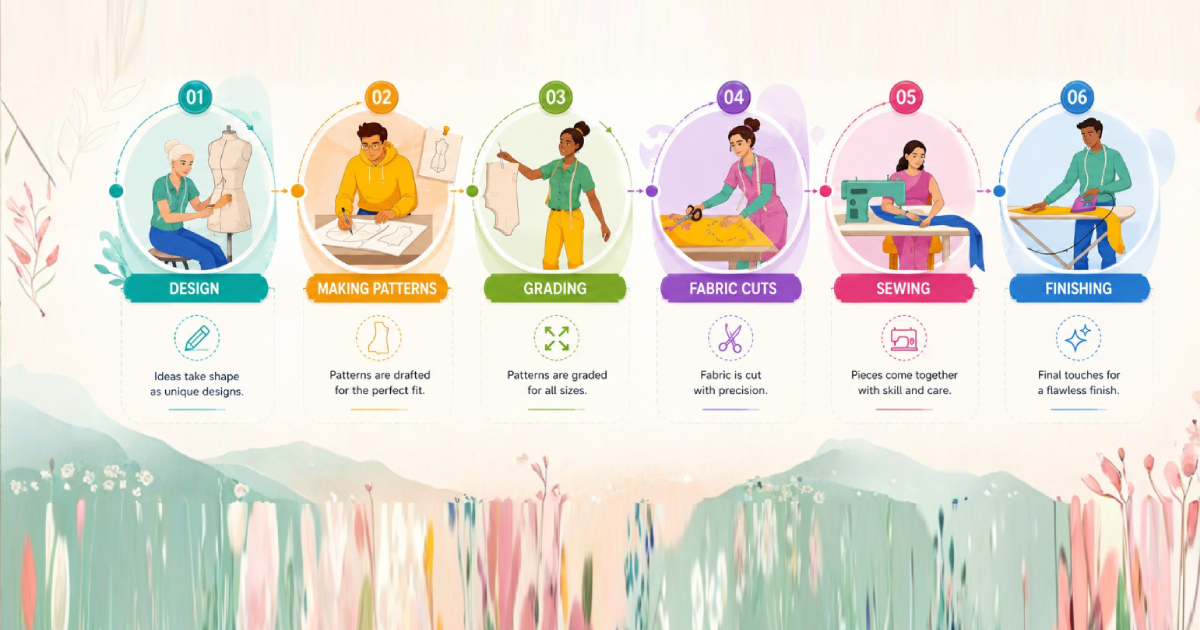
Wings2Fashion runs both cut and sew manufacturing and private label manufacturing under the same in-house production process, covering fabric sourcing, pattern making, sampling, bulk production, and finishing.
For private label manufacturing, the team works from an established base garment style, applying your labels, packaging, and branding across categories including women's wear, men's wear, activewear, and kidswear. For cut and sew manufacturing, the team builds custom pattern making around your tech pack or design brief, whether that arrives as a finished spec sheet or a mood board and a rough idea.
Not sure which manufacturing process fits your brand? Contact Wings2Fashion with your design or reference images, and the team will recommend cut and sew manufacturing or a private label manufacturing process based on your budget, timeline, and category.
FAQs About Cut and Sew vs Private Label Manufacturing
Can I start with private label manufacturing and move to cut and sew manufacturing later?
Yes. Many brands launch their first collection through a private label manufacturing process to validate demand, then move specific hero styles into cut and sew manufacturing once those styles prove themselves in the market.
Is cut and sew manufacturing always more expensive than private label manufacturing?
Per unit, cut and sew manufacturing usually carries a higher development cost because of custom pattern making. Per unit at scale, the gap narrows, since a cut and sew pattern is a one-time development cost amortized across every future reorder.
Does private label manufacturing mean my product looks the same as a competitor's?
Not necessarily. Private label manufacturing starts from a shared base garment style, but fabric choice, colorway, trims, and branding can differentiate the finished product meaningfully, even though the underlying pattern is shared.
Which model has a lower MOQ, cut and sew or private label?
Private label manufacturing generally supports a lower MOQ per style, since the base garment style spreads tooling and pattern costs across multiple brands rather than one.
Can a single collection mix cut and sew manufacturing and private label manufacturing?
Yes, and many established brands do exactly this. A hero style with a proprietary fit goes through cut and sew manufacturing, while core basics like tees, tanks, and hoodies run through a private label manufacturing process on an existing base garment style. This mixed approach protects budget on high-volume basics while still giving the brand one or two signature pieces built entirely around its own pattern.
Choosing Between Cut and Sew and Private Label for Your Next Collection
Neither cut and sew manufacturing nor private label manufacturing is the better model in the abstract. The right choice depends on whether your brand's advantage lives in the silhouette itself or in everything built around it. A founder testing a new category benefits from the speed of private label manufacturing. A founder with a defined, ownable fit benefits from the investment cut and sew manufacturing requires.
Ready to move forward with either model? Get in touch with Wings2Fashion to discuss your design, your budget, and your timeline, and the team will scope a cut and sew or private label manufacturing process suited to your first order.
 +919540322227
 info@wings2fashion.com



 Category

 Best Clothing Manufacturers for Startups USA
 Step-by-Step Garment Manufacturing Process
 Custom Streetwear Manufacturer for Global Brands
 How Much Does It Cost to Start a Clothing Brand?
 Best Garment Manufacturer Australian Brands
 Custom Clothing Production for European Fashion Brands
 Sustainable Hoodie Manufacturer for Startups
 Top 25 Women's Western Wear Trends
 How to Verify a Clothing Manufacturer Before You Pay a Deposit
 Free Tech Pack Template for Startups
 MOQ in Clothing Manufacturing
 India vs China Clothing Manufacturing
 Custom Clothing Manufacturer for UK Brands
 Plus Size Clothing Manufacturing
 Athleisure Manufacturing Trends
 Best Trending Styles Polo T-Shirts for Men
 Top 10 Custom Tracksuit Manufacturers With Low MOQ
 Black Essentials Hoodie Outfit Ideas for Every Season
 Custom Jogger Manufacturing Tech Pack Bulk Production
 2026-10-13
 Suraj Vats





Leave A Comment